A Matter of National Importance
The Main Reasons for Action
- The Commonwealth of Australia Constitution dates from the year of 1900 and although the product of referenda in the colonies, it is an act of the British Parliament. In practice, it and its Australian counterpart have proved almost impossible to amend and there is no provision for replacing it.
- Sovereignty is centred in Britain, not the people of Australia.
- There is no valid reason why Australian money should have been privatised in 1959 and the fact that it is, has and continues to:
- cause a significant and unnecessary increase in the cost of living;
- stifle investment in infrastructure, education, healthcare and housing;
- finance both sides of all the major wars for the past 50 years; and
- finance both sides of the Covid conspiracy.
- The housing market in terms of construction and sales has undergone an historic decline whilst increasingly higher and widely fluctuating interest rates for house mortgages has locked out a large number of young Australians from ever owning a home.
- The public health care system is inadequate and the cost of privatised health care is beyond the reach of most Australians. There is no provision for dental health.
- The cost of higher education has put higher academic attainment outside the reach of millions of young Australians. This is causing a corresponding decline in the value of Australia's most valuable asset, its human capital.
- Until 1967, there was no reference to the people of the First Nations in the constitution, except for the fact that the Commonwealth could not make laws for their benefit and they were not to be counted in the census. The various subsequent efforts at reconciliation have been little else than sad jokes.
- Since privatisation of Australian money in 1959 many farmers and home owners have been forced off their land and into bankruptcy due to banker's boom and bust cycles.
- Australian Local Governments are not recognised in the Constitution, nor do they a have a guaranteed source of funding which adversely affects their ability for long-term planning and provision of needed social services.
The Main Benefits Obtainable by Enactment of the Proposed new Constitution and Money Laws:
- At last, after two unsuccessful referendums, Australian Local Governments will be recognised in the Australian Constitution and will have guaranteed funding for all their expenditure. The practice of collecting rates will in future be undertaken by the ATO. (Ref. Articles 130, 131, 132 and 133 of the new constitution)
- The new constitution mandates that we become a non-aligned republic ensuring that the powers of war and peace are matters for the Australian Parliament; ending 250 years of Australians fighting England's wars. Hopefully the legislative changes will come before we're finally committed to World War 3 against China.
- The new constitution mandates a dirigiste form of government with a policy of import substitution. With the new money laws we will now be able to undertake the large number of infrastructure projects languishing for want of funding which will enable Australia to further reduce the cost of living, ensure full employment, maximise the value of our natural resources, increase manufacturing capabilities, reduce importations, improve transportation of people, goods and commodities, improve all forms of communication including space based IT services and free telecommunication services, repair, flood-proof and seal dirt roads, construct a new heavy rail freight and logistics facility servicing the entire nation, flood mitigation and dam construction aligned with management of fresh water resources, provision of additional renewable energy harnessing hydro and tidal forces, eliminating tax on labour and consumption.
- With new money laws we will buy back Australia's central bank and all the other national assets privatised by previous governments, e. g. air and sea ports, Telstra, Qantas, Australian National Railways, Victorian Electricity Generators and Distributors, Commonwealth Oil Refineries, Commonwealth Serum Laboratories, electricity and natural gas supply companies in Victoria, Melbourne Public Transport, Electricity Trust of South Australia, Medibank and Commonwealth Industrial Gases.
- With new money laws and in accordance with the new constitution all public universities are to be fully funded by the government. This will over time ensure increased enrolment and numbers of graduates. It should also ensure that the academic responsibilities of universities will no longer be compromised by alternative funding entities and hopefully bring about cessation of harsh and unfair censorship of student demonstrations objecting to the genocide in Palestine and other government mis-deeds.
- With likely increased funding to TAFE colleges and other higher learning activities directed to productive economic activities, new infrastructure projects and a substantial increase in housing, building and engineering projects will ensure a healthy volume of work for architects, builders, engineers and tradesmen and women.
- The new constitution guarantees that everyone shall have a home (ref Article 40).
- The new money law creates a Monetary Authority within the Australian Treasury to "pursue a monetary policy based on the governing principle that the supply of money in circulation shall not become inflationary nor deflationary in and of itself, but will be sufficient to allow goods, services and commodities to move freely in trade in a balanced manner" and other relevant checking procedures will ensure that bankers' boom and bust cycles become a thing of the past.
- The new constitution ensures that the people of the First Nations finally achieve a durable treaty. "The people of the First Nations and new settlers of Australia shall be equal and as one". (Section 1, Chapter 1, Article 1.) Also "Australia shall guarantee the rights of indigenous people according to the universally recognized principles and norms of international law and international treaties and agreements of Australia. The rights of the peoples of the First Nations and new settlers are one and the same". (ref. Article 69 clauses 1. and 2.)
Further Reading and Suggestions to Implement This Proposal:
- The two interdependent pieces of proposed legislation, the subject of the plebiscite comprise the core of my wider investigation into how Australians can attain sovereignty without resorting to war. Readers may download a copy of that document Australian Manifest – shifting the overton window.
- I will draft the 2028 referendum argument for a YES vote and submit it to the participating challenged entities for approval.
Some final thoughts on Democracy, Sovereignty and Dirigisme:
Most Australians would consider that our present system of government is democratic, but that view is most certainly incorrect! According to Merriam Webster "A democratic system of government is a form of government in which supreme power is vested in the people and exercised by them directly or indirectly through a system of representation usually involving periodic free elections." Now consider that "our parliamentary representatives must pledge allegiance to the British monarch before taking their seats". Sovereignty is vested in the monarch, not the people! Furthermore, the monetary powers are now vested in the privately owned Reserve Bank of Australia and the four major trading banks are also owned by private interests. From these facts it's obvious that we do not have a democracy, nor is Australia a sovereign state!
We Australians are in a colonial trap that seemingly has no escape hatch. Without sovereignty we have no pathway to choose our laws and worse still, we can't create our own money; we're forced to borrow it from private interests who create it from thin air and charge us interest.
This is an existential issue! Our neo-colonial and financial rulers are unlikely to relinquish their powers voluntarily. But if this plebiscite is supported by a very large percentage of the population, that would be a strong reason for the government of the day to authorise a compulsory referendum during the 2028 election period. If the yes votes exceed the no votes and these bills are approved by the Governor General and become acts of parliament, we then have achieved the means to defend our actions; we achieve sovereignty. But if the Governor General acts to prevent enactment of the proposed legislation, then we must declare independence like the 13 American colonies did on 4th July 1776.
The most outstanding example of a modern well balanced dirigiste economy is that of China in its reduction of poverty, it's amazing. The statistics don't lie.
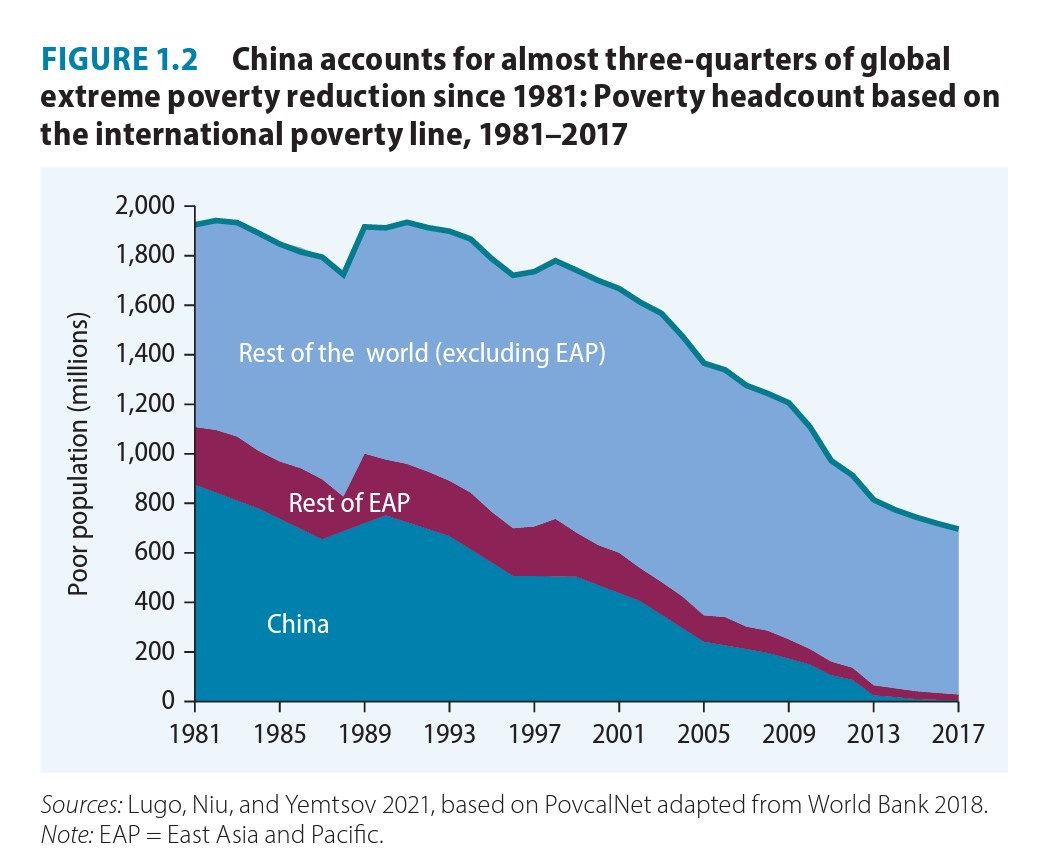
China lifted nearly 800 million people out of extreme poverty. And according to the World Bank, China is responsible for three-quarters of global reduction in extreme poverty. China has gone from being one of the poorest countries in the world to having the largest economy on Earth in 20 years, when you measure its GDP at purchasing power parity (PPP). China has been able to combine the best part of state planning and socialism with a market economy, and has been able to balance the political, social and monetary forces, and that's with only a few state-owned banks. "The Peoples Bank of China (PBOC) is still Rothschild controlled." In China there is a single holistic political party. And here's an example of what happens when a dirigiste government balances the political, social and monetary forces for the benefit of the citizenry as a whole.

The Chinese now produce more engineers and scientists than all the Western countries combined. That's what dirigisme with evenly balanced political, social and monetary powers can do.
Like China, the Australian dirigiste system I'm proposing doesn't have any political parties because political parties are partial interest parties, or partisan interest entities. Instead, our new constitution provides that: "The supreme direct expression of the power of the people shall be referenda and free elections with proportionate voting".
I think we should introduce an education program for public administration with a series of exams and tests to qualify government employees and elected representatives for local and federal government positions. And perhaps over time, experience in local government should be a prerequisite for those standing for federal government positions.
In my opinion we need to have a serious discussion as to whether the judicial powers should be separate or part of the government.